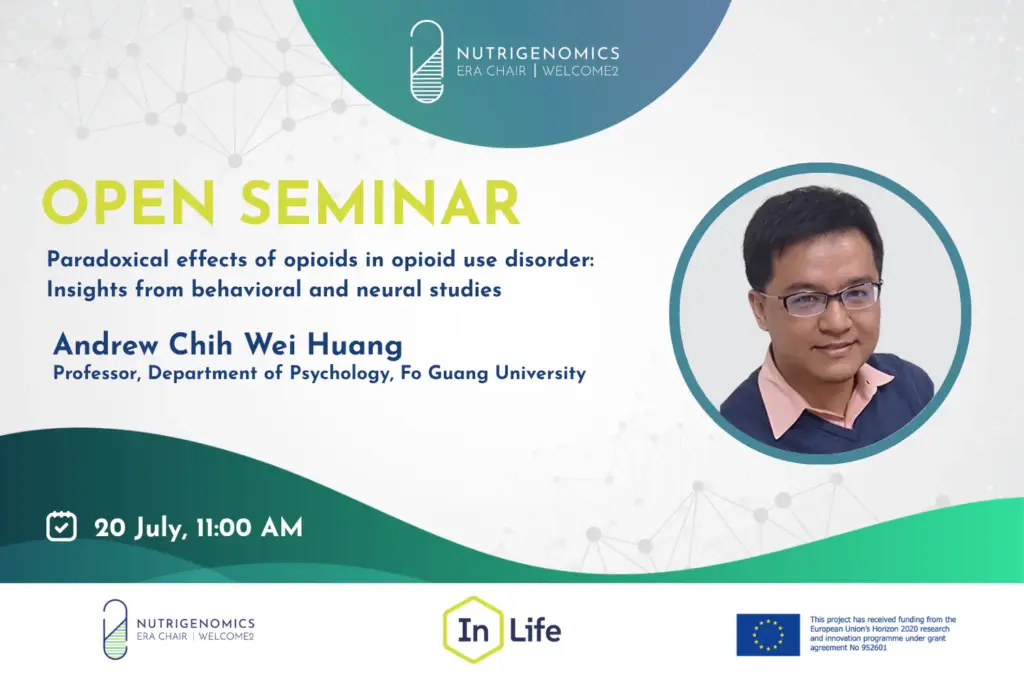
Professor Andrew Chih-Wei Huang from Fo Guang University (Taiwan), a leading expert in behavioral neuroscience, will be the guest of the upcoming Open Seminar organized within the WELCOME2 ERA Chair project.
Professor Huang’s research focuses on the neural mechanisms of drug addiction and psychiatric disorders, with particular emphasis on opioid use disorder. His work combines behavioral neuroscience, animal models, optogenetics, and molecular approaches to better understand the brain mechanisms underlying addiction and to identify novel therapeutic strategies.
The seminar will provide a unique opportunity to hear firsthand from a leading researcher, gain insights into the neural mechanisms of opioid use disorder, and explore the latest advances in addiction research.
Seminar Title: Paradoxical effects of opioids in opioid use disorder: Insights from behavioral and neural studies
Date & Time: 20 July, 11:00 AM
Place: InLife Institute of Animal Reproduction and Food Research PAS, 18 Trylińskiego St., Conference Room “SKANDA”
We look forward to seeing you there!
Abstract
Opioid use disorder (OUD) is a severe psychiatric condition that poses long-term societal challenges worldwide. Approximately 26.8 million people meet the DSM-5 diagnostic criteria for OUD, experiencing symptoms of opioid intoxication and withdrawal. Both the United States and Iraq have a high prevalence of OUD, ranging from 1.05% to 1.30%. This widespread opioid consumption contributes to significant public health and crime-related issues. A series of studies suggests that the rewarding effects of opioid intoxication manifest as euphoria, while the aversive effects are characterized by dysphoria and agitation. Additionally, the behavioral symptoms of opioid withdrawal closely resemble those associated with aversion, including depression, anxiety, and suicidal tendencies. These clinical rewarding and aversive symptoms are linked to findings from preclinical studies, forming the basis of the so-called paradoxical effect hypothesis of opioid abuse. The present study examines extensive evidence demonstrating that morphine administration can simultaneously induce paradoxical effects – reward and aversion – both behaviorally and within neural mechanisms in the brain. Furthermore, factors such as footshock stress and anti-stress environmental enrichment can alter these paradoxical effects. Future research should explore novel pharmacological therapies – such as brain-derived neurotrophic factor, neuroinflammation modulation, and purinergic system targeting (e.g., P2X7 receptor) – as well as interventions that shift stimulus valence from reward and aversion to a neutral state. These strategies may help develop innovative approaches to mitigating the symptoms of OUD.
Speaker Biography
Andrew Chih-Wei Huang is a Professor of Psychology at Fo Guang University and a behavioral neuroscientist specializing in the neural mechanisms underlying psychiatric and neurological disorders. His research uses animal models, behavioral neuroscience, optogenetics, and molecular approaches to investigate drug addiction, post-traumatic stress disorder, depression, anxiety, and central post-stroke pain. His recent work has proposed the “paradoxical effect hypothesis” to explain the concurrent rewarding and aversive effects of addictive drugs. He also studies prefrontal–amygdala circuitry, gut–brain interactions, neuroinflammation, and the repurposing of psychiatric medications for neurological disorders. His long-term goal is to translate basic neuroscience findings into targeted treatments for psychiatric and neurological conditions.